TL;DR / Start with the useful work
Do you need to start again for AI search?
No. Start with useful answers and clear facts about your offer.
- Worried about falling behind? Check the basics before buying more work.
- Comparing agencies? Ask what they will change and how they will measure it.
- Ready to act? Choose one customer question and improve the page that answers it.
Article link: https://stillmatter.marketing/blog/aeo-geo-seo/
Look, did search really need more acronyms?
SEO. AEO. GEO. Finding a business now sounds a bit like reading the back of a router.
We're not convinced every new label comes with a whole new discipline beneath it.
A clear service page still helps. So does a website people can use and search tools can access.
But the way people search is changing. AI can explain an answer, compare choices and help with a task.
That gives us more to consider than a place in a list of links.
So, AEO and GEO it is. Let's make the work behind the names clear.
What is the difference between SEO, AEO and GEO?
The labels overlap. These are working definitions, not three separate sets of rules.
SEO: search engine optimization
SEO helps people find useful content through search. It covers the content and the website behind it.
- The question: can the right person find the right page?
- The work: answer real questions and make the website easy to access.
AEO: answer engine optimization
AEO focuses on information used in answers. Think clear explanations of the questions your customers ask.
- The question: is there a clear, reliable answer to use?
- The work: explain the subject, support the facts and keep them current.
GEO: generative engine optimization
GEO focuses on visibility in answers made by AI. That may include a brand mention or a linked source.
- The question: does the answer describe your business accurately?
- The work: check the offer, supporting facts and sources an answer uses.
You may also see LLMO: large language model optimization. A large language model generates language; an application can connect it to search and other tools. Ask whether a proposal changes your website, checks external sources or builds a separate application. Those are different scopes, even when the label is the same.

Read diagram text
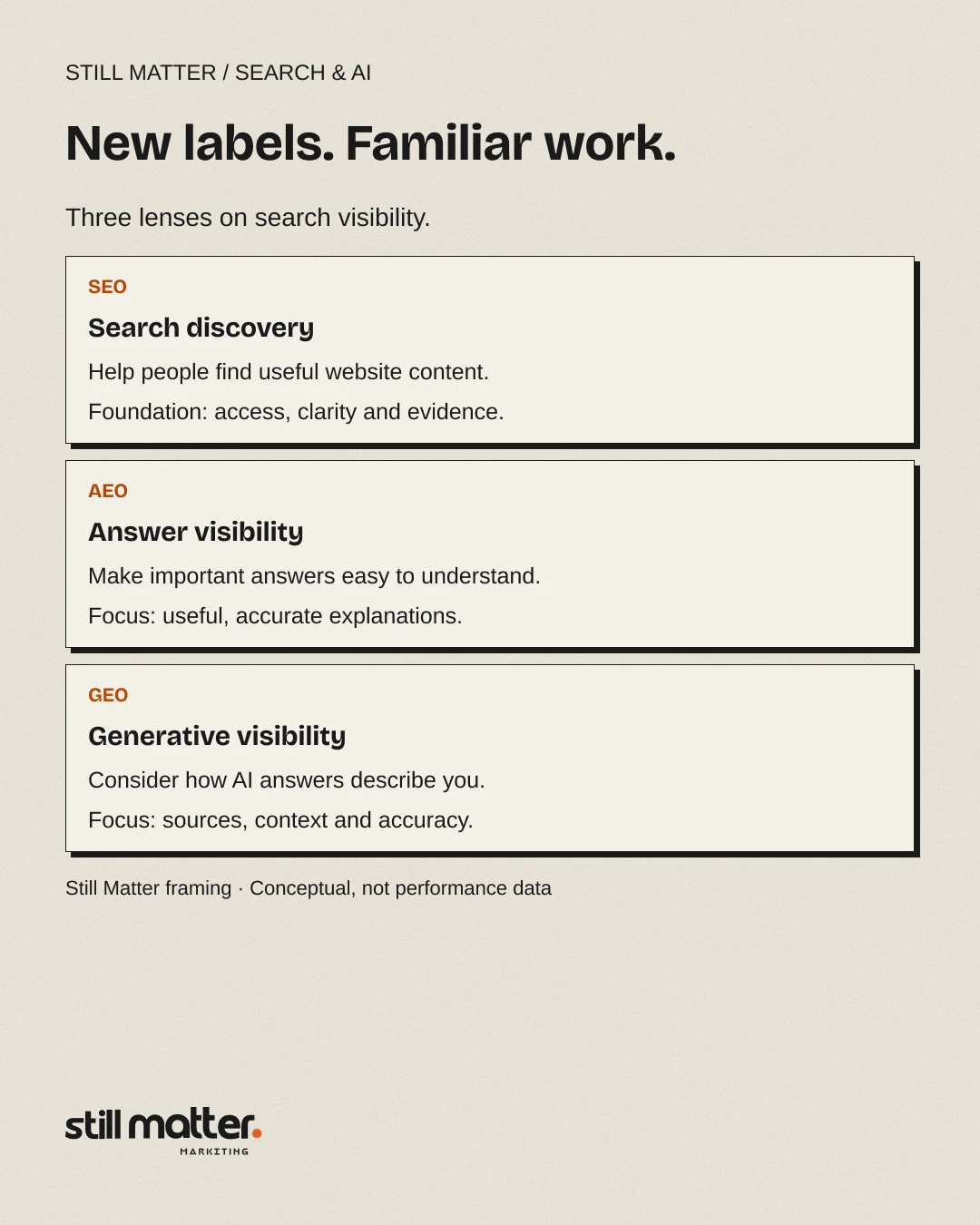
New labels. Familiar work.
Three lenses on search visibility.
- SEO: search discovery
- Help people find useful website content. Foundation: access, clarity and evidence.
- AEO: answer visibility
- Make important answers easy to understand. Focus: useful, accurate explanations.
- GEO: generative visibility
- Consider how AI answers describe you. Focus: sources, context and accuracy.
What does AIO mean?
In Google Search discussions, AIO often refers to AI Overviews. In an agency proposal, it may instead mean AI optimization. Ask the writer to spell it out and name the platform and work involved.
AI Overviews and AI Mode are Google experiences. AEO and GEO describe overlapping approaches to improving visibility. A product name and a service label answer different questions.
The answer can become part of the search.
People can still choose a website from a list. They can also ask AI to explain or compare the options.
A follow-up question might add a budget, location or need. That can change which choices seem relevant.
Google says its AI search features can run several related searches to explore a question.
It calls this query fan-out. That doesn't mean you need a page for every possible wording.
For Google, existing SEO work remains relevant. Its AI features use its search ranking and quality systems.
Read Google's AI search guide for its current advice. Other providers may work differently.
Where does agentic search fit?
Agentic search is a broad label for tools that plan searches or help carry out a task over several steps.
For example, Google described AI Mode checking restaurant availability across partner sites in August 2025.
People still completed the booking themselves in that example. It doesn't show what every tool can do today.
See Google's dated announcement. Check the current tool before promising a task will work.
- Find: show a useful source.
- Explain: help someone understand the choices.
- Act: help with a task, with clear permission and review.
Help people understand why your offer fits.
Covering the topic is only part of the job. Explain why your offer suits a particular customer's needs.
A service page should help answer four questions:
- Who does it help? Name the customer and their needs.
- What does it do? Explain the job your product or service handles.
- When does it fit? State the useful situations and limits.
- What supports it? Give accurate details and credible evidence.

Read diagram text
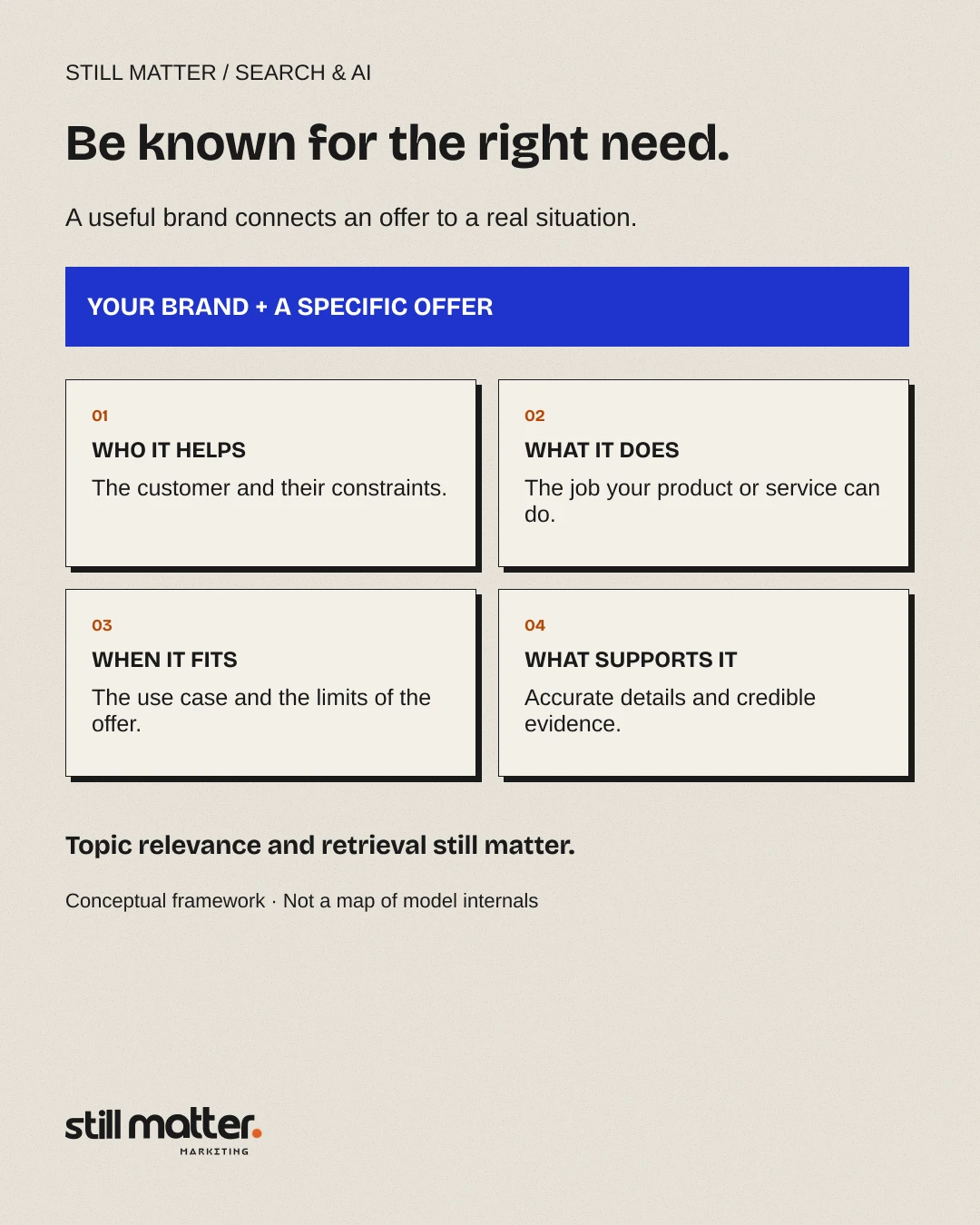
Be known for the right need.
Your brand and a specific offer.
- Who it helps
- The customer and their constraints.
- What it does
- The job your product or service can do.
- When it fits
- The use case and the limits of the offer.
- What supports it
- Accurate details and credible evidence.
Topic relevance and retrieval still matter.
What does the research support?
A September 2026 study tested brand suggestions across six AI models and five product categories.
Questions with specific needs could surface different brands from broad category questions.
But this is an early paper, not yet peer reviewed. The tests also had web search switched off.
It supports checking buyer context. It doesn't prove that editing a page will make AI recommend your brand.
Read Malthouse and colleagues' brand study for the method and limits.
This doesn't replace SEO. Search used links between brands, products and other things before generative AI.
Noy and colleagues' 2019 paper describes that earlier use of knowledge graphs.
Separate a brand association from a recorded fact.
A brand association is something a person connects with a brand. A fictional heating company may want customers to think of planned maintenance, but customer conversations may reveal a different impression. Check that difference before treating your intended position as established.
A knowledge graph records entities and their relationships. Describing the company, its services and its location accurately helps readers understand those facts; it does not establish that a search provider has accepted a graph entry. Human associations, structured facts and a model’s answer are different things to investigate.
An unclear offer needs facts, not another acronym.
Imagine a small bookkeeping firm. This is a fictional example, not a client result.
Its homepage promises “financial clarity for ambitious businesses.” The customer still has a few questions.
- Do you work with businesses like mine?
- What does monthly bookkeeping include?
- Is tax advice part of the service?
- What do you need before we can start?
An AI tool comparing providers has those same missing facts to work around.
The first useful change is to explain the offer. A separate “GEO page” wouldn't solve that gap.
A clearer version could say:
“Monthly bookkeeping for small service firms using Xero.”
“Includes transaction checks and monthly reports.”
“Tax advice is outside this service. Bring your current records to the first conversation.”
Those details are made up for this example. Use only facts your own business can support.
Our brand messaging framework can help turn a vague promise into a clear explanation.
Start with one service and one customer decision.
You don't need a second version of the business written just for AI. Start with the information you maintain.
- Choose a question. Use one that comes up in real customer conversations.
- Read the answer. Can someone new understand the offer and its limits?
- Check the facts. Keep names, services, locations and contact details accurate.
- Test the next step. Try the relevant link or enquiry route on a phone.
- Name an owner. Decide who will keep the information current.
Give a different question its own page when the reader needs a different answer or action.
Use the maintainable content plan to choose the next useful answer.
Keep access choices separate
Appearing in search and allowing model training are different decisions.
OpenAI documents separate search and training crawlers. Ask your website team to check the relevant controls.
Use OpenAI's crawler documentation, not a blanket rule for every bot.
For Google, check search access and the current AI inclusion settings in Search Console.
Eligibility does not guarantee that Google will show a page. See its AI features guidance.
Found, named and chosen are different outcomes.
A source can be found and left out of the answer. A business can be named without being recommended.
A recommendation can still be wrong for the buyer. Keep these checks separate:
- Mention: does the answer name your business?
- Citation: does it link to a source, and which one?
- Visit: did someone reach your website and get recorded?
- Useful enquiry: did someone with a relevant need get in touch?

Read diagram text
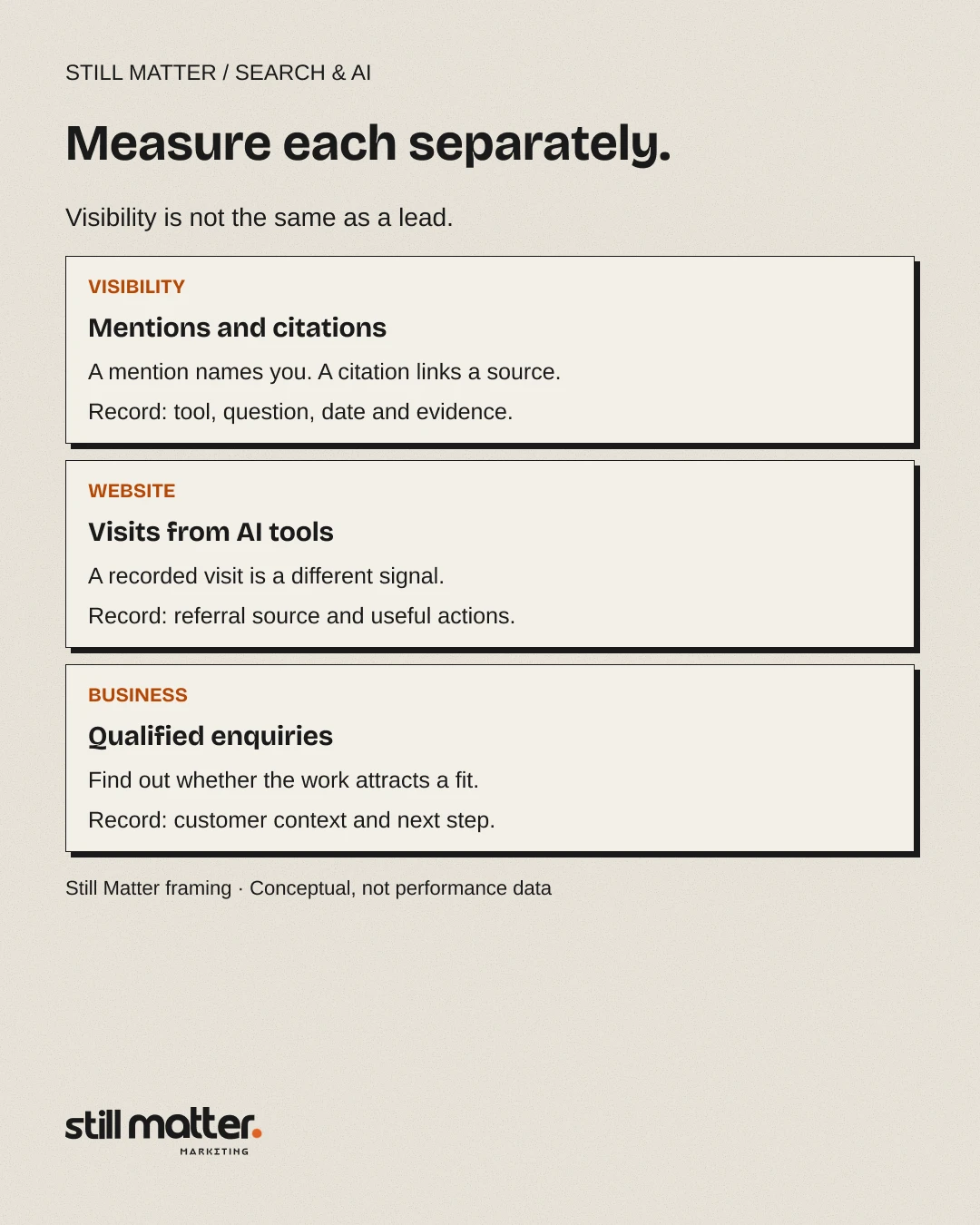
Measure each separately.
Visibility is not the same as a lead.
- Visibility: mentions and citations
- A mention names you. A citation links a source. Record: tool, question, date and evidence.
- Website: visits from AI tools
- A recorded visit is a different signal. Record: referral source and useful actions.
- Business: qualified enquiries
- Find out whether the work attracts a fit. Record: customer context and next step.
Keep a small, useful record
Choose a few questions that reflect real buying decisions. Save the exact wording and the tool you used.
Record the date, answer, links and any errors. Repeat the checks; one answer is only one observation.
Google's generative AI performance report records AI Overviews and AI Mode impressions.
An impression is exposure, not a visit or enquiry. Check the report's limits before drawing conclusions.
Our content measurement guide explains how to keep missing data and uncertain results visible.
Pay for clear work, not a guaranteed mention.
AEO or GEO support can be useful. Ask for a clear problem, a defined scope and work you can inspect.
- What gap have you found in our site or the way we're described?
- Which changes are included, and who will make them?
- What does your report count, and what does it leave out?
- Which results depend on tools you don't control?
A supplier can commit to good work. It cannot control every answer a platform chooses to show.
Be cautious about promises that repeated brand mentions will “train AI” to recommend you.
We haven't found evidence that supports that as a reliable rule for a business.
For help choosing the work, explore Content & growth or tell us what needs attention.
A few questions before you start.
Does GEO replace SEO?
No. Clear content and search access still matter. AI answers add new things to observe.
Do I need separate AEO and GEO pages?
Only if they help readers with different decisions. A new label alone doesn't earn another page.
Should I add an llms.txt file for Google?
Google says it ignores these files. They do not help or harm your visibility in Google Search.
Other systems may use them. Check a named provider before adding more upkeep.
How long will it take to get recommended?
There is no dependable deadline. Agree the work and review method rather than a guaranteed recommendation.
Is one missing AI mention a reason to rewrite our site?
No. Save the question and check the facts first. Answers vary, and one response is a weak basis for change.
A few terms worth knowing.
- AI visibility
- How a business or its information appears in AI answers and search experiences.
- Citation
- A link or reference to a source. It may point to someone else's page.
- Query fan-out
- Related searches a system runs to explore parts of a question.
- Agentic search
- Tools planning searches or helping with a task over several steps.
- Preprint
- A research paper shared before formal peer review.
What this guide is based on.
Sources checked on 20 October 2026. Platform features and controls can change.
The advice and diagrams are Still Matter frameworks. The bookkeeping example is fictional.
Research findings have limits. None of the linked studies guarantees results for your website.
- Google: AI search guidance — current platform advice.
- Google: AI features and your website — access and eligibility.
- Google: generative AI performance report — measurement and limits.
- OpenAI: crawler controls — search and training access.
- Malthouse and colleagues, 2026 — early brand study, with web search disabled.
- Noy and colleagues, 2019 — entity relationships in earlier search systems.
- GEO, KDD 2024 — tested source-content changes and visibility within a research setting.
Useful information. Clear choices. Evidence you can check. Search is changing; good judgment still matters.

Written by Jake Tripp
Founder of Still Matter. Brand strategy and hands-on marketing for small and growing businesses.