TL;DR / A useful place to start
Where should a small business start with AI visibility?
Check how AI describes your business. Fix the facts that matter to customers.
- Running the business yourself? Improve one important service page before adding more content.
- Handling marketing for the team? Keep a shared record of questions, answers and corrections.
- Considering outside help? Ask for a clear problem and work you can inspect, not a guaranteed mention.
Being mentioned is a start. Being understood matters more.
Your business appears in an AI answer.
Good news, until you notice that it lists a service you stopped offering.
That mention might make you visible. It could also send the wrong people your way.
AI visibility describes how a business or its information appears in AI answers and search experiences.
Can the right customer find accurate facts and take a useful next step?
That could mean checking your service area, comparing an offer or finding a working contact link.
Visibility is only part of the job. The answer still needs to describe a business that can help.
For the terminology, read our AEO, GEO and SEO comparison. This guide focuses on where to begin.
Start with the decision your customer is trying to make.
You don't need to chase every question an AI tool could answer.
Choose one service and one customer decision.
Use questions from real sales calls, emails or conversations.
A small, relevant set is easier to review and maintain.
- Finding help: what kind of business handles this problem?
- Comparing options: does this service fit my needs and budget?
- Checking the details: what is included, and what happens next?
These are writing prompts, not measured customer queries.
Replace them with the language your own customers use.
A local repair firm and a national software provider need different answers.
Your content should make that difference clear.
Follow the question without multiplying pages.
A customer asking about boiler repairs may also need to know the service area, hours and booking process. Those details can live together on the repair page. Give a different task its own guide only when it needs a distinct answer.
Query fan-out describes related searches a system may run. It is not a list of pages your business must publish. Use topic ownership to give each customer question one main answer, then link to useful follow-ups.
Check what you already have.
A content audit asks whether the current page answers the customer’s question accurately. A content gap is a useful answer that is missing or incomplete.
For the fictional repair firm, missing booking hours could be one section to improve. A competitor having ten articles does not establish ten gaps in your own site. Record the question, the existing answer, the missing fact and who can confirm it. Use the content-plan worksheet to choose work the team can keep accurate.
Make it clear who you help, and when you fit.
Look at the page for that service. Could someone new explain what you do after reading it?
Give them the details they need to decide: the customer you serve, the work included, your limits and the next step.
Support claims with evidence you can show.
That might be a real project, a qualification or a clear account of your process.

Read diagram text
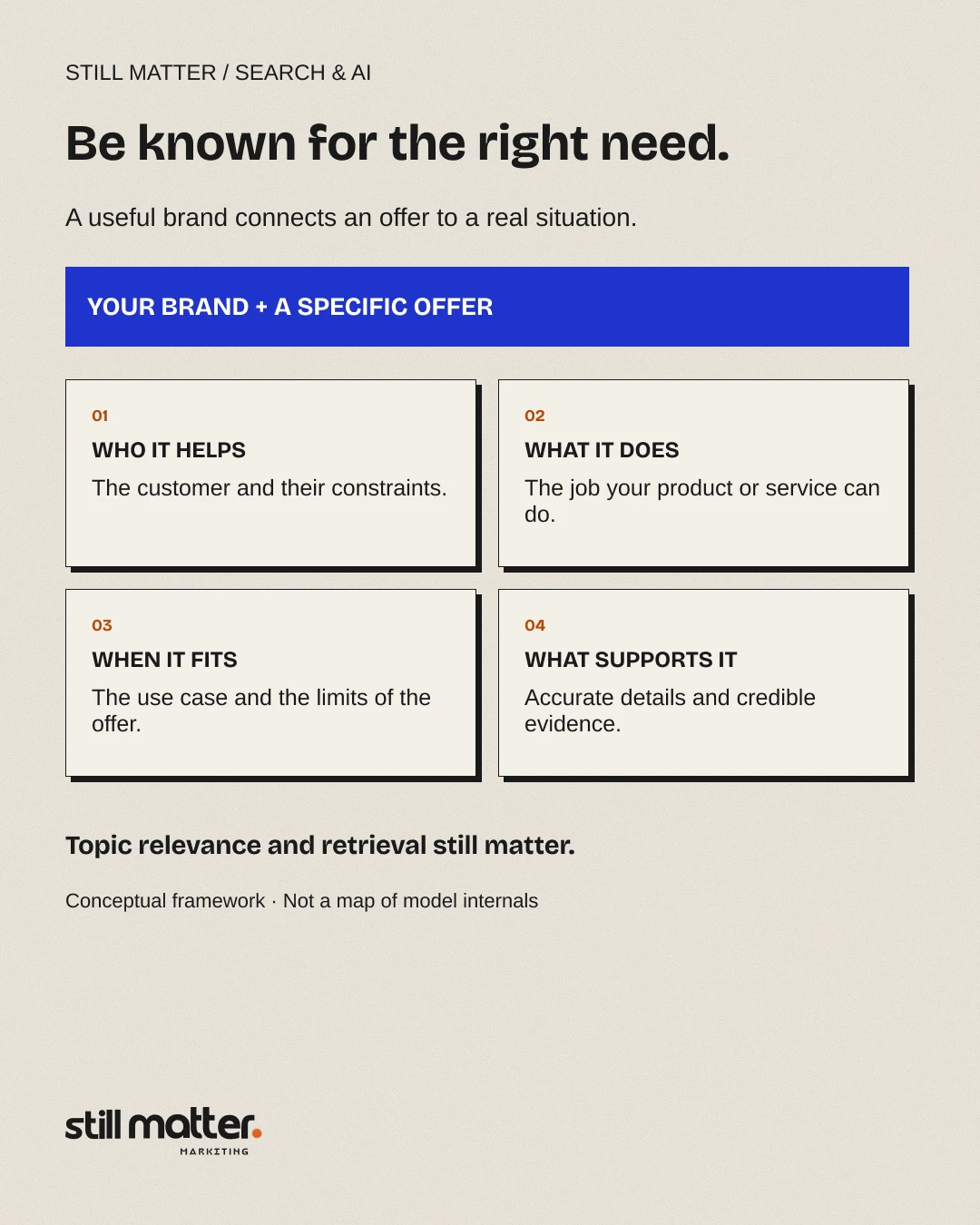
Be known for the right need.
Still Matter / Search & AI
A useful brand connects an offer to a real situation.
Your brand + a specific offer
- 01 / Who it helps
- The customer and their constraints.
- 02 / What it does
- The job your product or service can do.
- 03 / When it fits
- The use case and the limits of the offer.
- 04 / What supports it
- Accurate details and credible evidence.
Topic relevance and retrieval still matter.
Conceptual framework · Not a map of model internals
Mobile wording: “Connect your offer to a real situation.” / “Your brand + offer”
Mobile note: “Conceptual framework. Not model internals.”
Google's AI search guidance still points website owners toward useful content and established SEO work.
For the wording itself, use our brand messaging framework. More labels won't fix an unclear offer.
A vague promise leaves useful details out.
Imagine a local heating business whose homepage says, “Comfort for every home.”
This is a fictional example, not a client result.
A customer with a broken boiler still has a few questions:
- Do you repair boilers, or only install new ones?
- Do you cover my town?
- Can I request an emergency visit?
- How do I find out what the call-out includes?
The first improvement is a clear repair page with truthful answers.
It could state the area served, booking hours and service limits.
Those facts give people more to work with. They also give search tools clearer information to find.
That is a content improvement, not proof that an AI answer will change.
Check the page and the answers separately.
Keep the important facts accurate and available.
Review the places you control.
Your website, business profile and social pages should reflect the business as it operates today.
- Use the current business name and a clear description.
- Check services, opening hours and areas served where relevant.
- Remove expired offers and explain meaningful service limits.
- Test the contact link or booking route on a phone.
These are Still Matter's upkeep checks.
Consistent information is not a promise that every AI tool will use it.
Ask your website team to check search access, too.
A useful page cannot help through a search system that cannot access it.
For Google, a supporting page must be indexed and eligible for a search snippet.
Meeting those conditions does not guarantee inclusion.
See Google's eligibility guidance. It says no special AI markup is required for these features.
Other providers have their own controls.
OpenAI documents separate search and training crawlers in its crawler guidance.
Have the relevant settings checked before changing them.
Search access and permission for training are separate decisions.
Being found and being used are different.
Retrieval is the step of finding relevant information. Grounding uses supporting information to inform a response. Finding your repair page does not mean a system will cite it, and a grounded response can still misread a service limit.
Keep the page specific: describe the work, where it is available and any exclusions. Then check the answer separately using the AI visibility audit. Record the source and any mismatch rather than assuming that access proves accuracy.
Save what you actually see before changing the site.
Try a few relevant questions in a tool your customers may use.
Treat this as a starting observation, not a full market survey.
Keep a simple shared note with the question, tool, date, answer and any linked sources.
Note the location or search setting when it matters.
Ask four questions as you read:
- Does the answer name the right business?
- Does it describe a service you actually offer?
- What source supports the details?
- Is there an important mistake worth checking?
Google says its AI features can show different answers and links.
One result cannot establish your overall visibility.
Check again over time and keep the wording you used.
Do not turn a small sample into a market-share claim.
If an answer is wrong, inspect the cited page before deciding what to fix.
The problem may be on your site or elsewhere.
You can correct your own pages and request updates from other publishers.
You cannot promise when an AI service will reflect a change.
Keep a mention separate from a useful inquiry.
A business can be named without a link.
A link can appear without bringing a visit.
A visit can end without an inquiry.
Keep these observations separate so a report does not make the work look more effective than it is.

Read diagram text
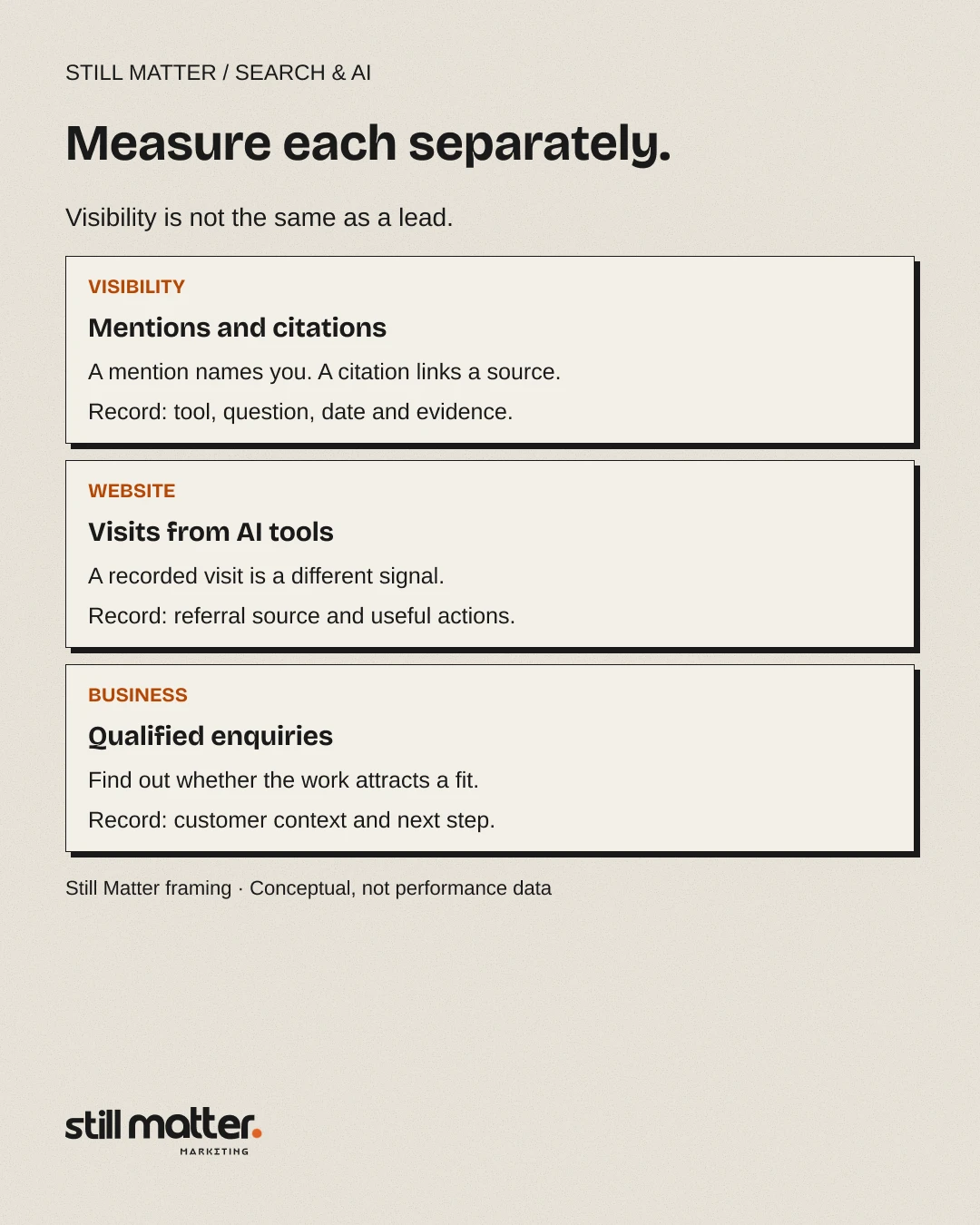
Measure each separately.
Still Matter / Search & AI
Visibility is not the same as a lead.
Visibility
- Mentions and citations
- A mention names you. A citation links a source.
- Record: tool, question, date and evidence.
Website
- Visits from AI tools
- A recorded visit is a different signal.
- Record: referral source and useful actions.
Business
- Qualified enquiries
- Find out whether the work attracts a fit.
- Record: customer context and next step.
Still Matter framing · Conceptual, not performance data
Mobile note: “Still Matter framing, conceptual, not performance data.”
Agree what a useful inquiry looks like for your business.
It should concern work you can do for a customer you can help.
Our content measurement guide explains how to keep missing data and uncertain results visible.
For related viewing, Google's Q2 2026 update discusses search reporting.
The rollout details are historical, not a current feature checklist.
Watch on YouTube. Use current provider documentation when interpreting a report.
Give one useful improvement an owner.
Choose the most important gap you found.
It might be an unclear service page, an old address or a broken contact route.
Write down what needs to change, who will handle it and when you will check it.
Keep a copy of the starting point.
When several people share the work, agree who keeps the facts current and approves changes.
Make the change, test the customer journey and review the result.
A completed repair is something you can verify without waiting for an AI mention.
- Do it yourself when the facts are clear and the page is easy to update.
- Ask your team when content, website access and reporting need different skills.
- Commission help when you need a defined review or lack the time to deliver the work.
Before hiring, ask what will be checked, what will change and how the supplier will show its work.
Our Content & growth service connects those priorities with practical delivery.
You can also tell us what needs attention.
When a customer needs to act, use our agentic search guide and customer-task worksheet.
A few questions before adding more work.
Does AI visibility replace SEO?
No.
Google says its AI search features still rely on its search systems.
Clear content and a usable website remain relevant.
The AEO/GEO/SEO guide explains the overlap.
Do I need a paid tool to start?
You can begin with a small manual check and a shared record.
That is our planning advice, not a full audit or a tool comparison.
If you later need more coverage, define the questions and reporting limits before buying software.
Why isn't my business in an AI answer?
One answer cannot tell you why.
Check the question, source links and facts.
Ask your website team to check search access.
Do not assume a missing mention proves that your website is broken.
Use our missing-business troubleshooting guide to choose a focused investigation or correction brief.
Can someone guarantee AI recommendations?
A supplier can commit to work it controls.
Ask for evidence and clear limits when a supplier promises an AI recommendation.
A few terms worth knowing.
- AI visibility
- How a business or its information appears in AI answers and search experiences.
- Citation
- A link or reference to a source. It may point to someone else's page.
- Qualified inquiry
- A relevant request from someone your business can help, with a useful next step.
What this guide is based on.
Primary sources checked on 20 October 2026.
Advice about a named platform applies to that platform, not every AI service.
- Google's AI search guidance — content and established search practices.
- Google's AI features guidance — access, eligibility and variation in answers.
- OpenAI's crawler guidance — separate search and training controls.
The workflow and diagrams are Still Matter frameworks.
The heating-business example is fictional.
No traffic gains or ranking results are claimed.
Start with a real need. Make the facts clearer. Keep the next step useful.

Written by Jake Tripp
Founder of Still Matter. Brand strategy and hands-on marketing for small and growing businesses.