TL;DR / Start with the task
Start with the customer’s task.
Agentic search can help a person work through a task, from finding options to taking an allowed next step.
The exact action depends on the service, its tools and the user’s permission.
For a business, the useful question is simple: what must a customer know and approve before that next step can succeed?
- Choose one real customer task.
- Make the facts and limits clear.
- Name the approval, receipt and human fallback.
Use the fictional journey to see those choices, then complete the open worksheet.
This is a planning guide, not a claim that an agent has tested your website.
An answer and a completed task are different things.
A search may help someone find a service.
An AI answer may compare options.
An agentic experience can use tools to pursue a goal across further steps.
Those steps might include checking availability, gathering details or helping make a booking.
A generated answer alone does not prove any action took place.
Here, agentic search means customer-facing discovery and action.
We are not covering developer retrieval systems or an agency using AI to write copy.
1. Find information
The person learns what a business offers and whether it fits.
2. Compare options
The system checks options against the person’s needs.
Unknown details still need an answer.
3. Take an allowed step
The person or service follows a supported route.
Approval and a clear result matter.
A journey may stop at any stage.
Finding a promising option is useful, but it is not a booking.
For the broader discovery question, start with AI visibility for small businesses.
The AEO, GEO and SEO comparison explains the related terms.
For broader context, this historical Wharton talk discusses generative AI at work.
It is not a demonstration of today’s search or booking features.
Check the named service, not just the label.
These examples were checked against Google’s primary documentation on 21 October 2026.
They describe documented features, not transactions we completed.
Restaurant research with a handoff.
Google’s August 2025 announcement described finding tables across sites.
People then followed a link to finish the booking.
This is a dated handoff example.
It does not establish today’s eligibility for every restaurant. Read the original announcement.
Some hotel bookings inside AI Mode.
Current Google help describes booking selected properties through a partner inside AI Mode.
The feature is limited to the US, English and eligible users.
The user checks details and proceeds through payment.
A successful booking has a confirmation number; the partner handles the booking and sends its email.
Some hotels instead offer a link to the partner’s site. Check Google’s current hotel-booking requirements.
Calls on a customer’s behalf.
Google’s business help describes automated calls for requests such as appointments.
A business may therefore receive a task through its phone team, not only its website.
The help page explains the controls and how these calls work. Read the business-facing guidance.
These are different flows.
A page that appears in search is not proof that an agent can book, pay or submit a form.
Check the specific tool, region, account and task before making a promise.
Make the offer and its limits easy to understand.
Start with facts your team can stand behind.
Name the service area, hours, offer, limits and contact route.
Keep changing details close to the place that owns them.
An old page saying “appointments available” does not establish a slot today.
A customer may need a quote, a check by staff or an intake call before booking.
State that limit clearly instead of making every route sound instant.
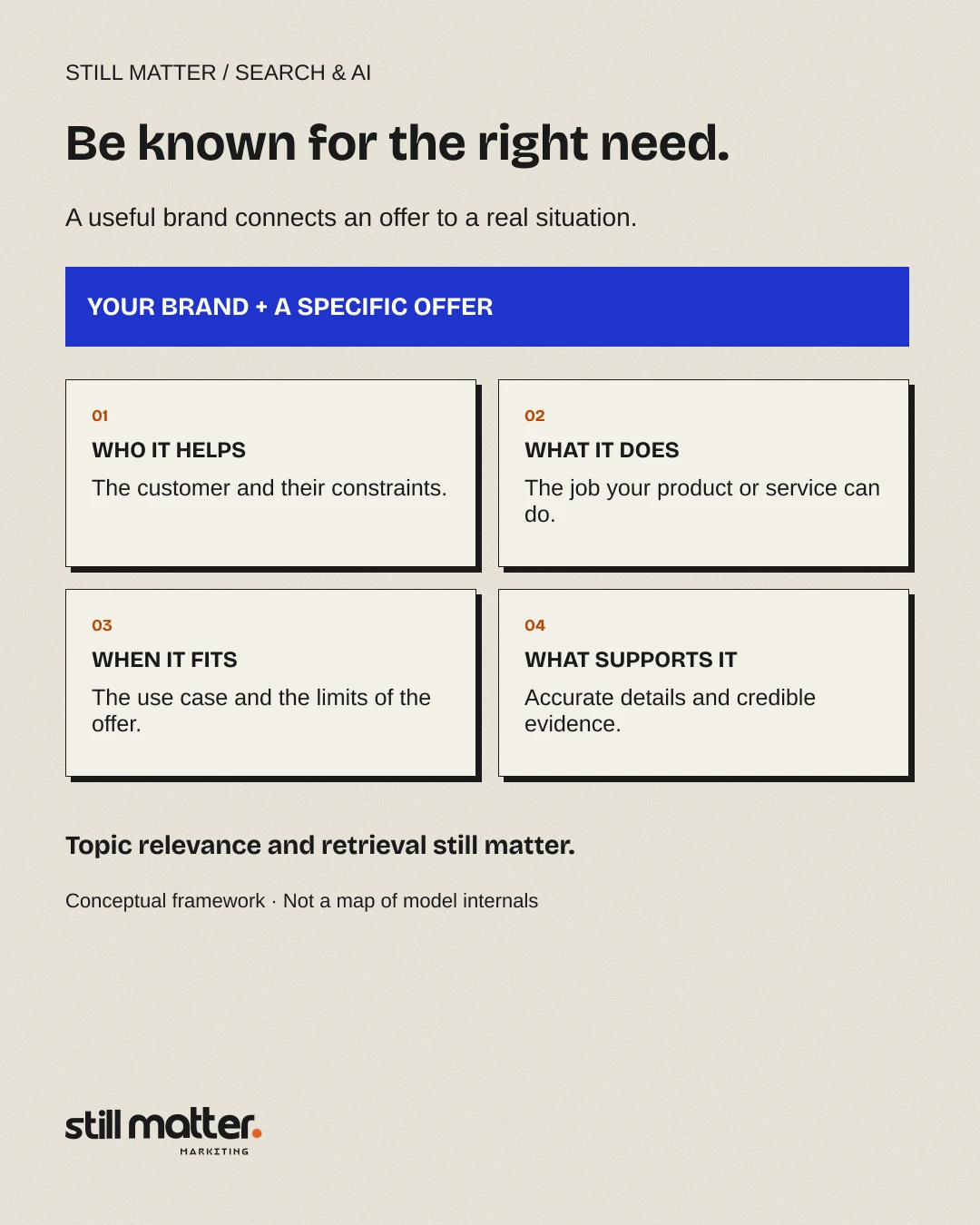
The planning model below connects an offer to a specific need.
It is not an agent-compatibility test.

Read diagram text
Be known for the right need.
Still Matter / Search & AI
A useful brand connects an offer to a real situation.
Your brand + a specific offer
- 01 / Who it helps
- The customer and their constraints.
- 02 / What it does
- The job your product or service can do.
- 03 / When it fits
- The use case and the limits of the offer.
- 04 / What supports it
- Accurate details and credible evidence.
Topic relevance and retrieval still matter.
Conceptual framework · Not a map of model internals
Mobile wording: “Connect your offer to a real situation.” / “Your brand + offer”
Mobile note: “Conceptual framework. Not model internals.”
For a wrong fact or missing mention, use the missing-business troubleshooting guide.
For collecting observations, use the AI visibility audit.
Follow one request from question to a real answer.
Imagine Cedar Cycle Works, a fictional bicycle repair shop.
A customer needs a commuter bike checked before Friday.
This is a conceptual walkthrough, not a tested product flow or a Still Matter client result.
No named AI platform is claimed to support this exact task.
1. State the need
The customer asks for a nearby repair shop that can assess a brake problem before Friday.
The task is to find a suitable assessment route.
It is not permission to buy a repair.
2. Check fit
The shop’s page names the area it serves, the bikes it accepts and how assessment works.
The customer’s bike type is still unknown.
Ask for it rather than assuming the shop can help.
3. Check the next available step
The page offers an assessment request.
Staff must confirm the time and any charge.
A search answer cannot turn that request into a reserved appointment.
4. Review before sending
The customer reviews the chosen shop, request wording and details to share.
Only an explicitly permitted, supported route may send it.
Otherwise the customer uses the normal contact route.
5. Read the receipt
“Request received” means the shop has the request.
It does not mean Friday is booked.
The shop’s later response must confirm the slot and any charge before the customer commits.
6. Handle uncertainty
If no receipt appears, the customer checks with the shop before trying again.
If Friday is unavailable, the shop offers a human next step.
No agent should invent a slot to finish the task.
The weak point might be unclear copy, stale availability or an ambiguous receipt.
Name the actual gap before commissioning a new system.
Map one task before choosing a tool.
Use this with the person who owns the service and the person who maintains its contact route.
Fill in one task at a time.
Download the plain-text customer-task worksheet.
It is ungated and requires no paid tool.
- Customer task
- What does the person want to achieve? What would count as a useful next step?
- Facts and limits
- Which facts must be current? Name their source, owner and any unanswered question.
- Supported route
- Where can this task happen today? Record the platform, region and date checked, or write “not verified”.
- Permission and review
- What can be read, prepared or sent? Who approves sharing details, a booking or a charge?
- Result and fallback
- What proves receipt or completion? Who helps if the result is unclear or the route fails?
- Owner and next action
- Name the person who will resolve the gap, the bounded change and the check that shows it works.
Use placeholders for customer details.
Do not put passwords, payment data or private requests in this worksheet.
Planning a task does not authorize a live submission.
Agree a test environment and its limits before testing an action.
Give the uncertain step a clear owner.
For the fictional bike shop, a useful worksheet would say:
- Task: ask whether a brake assessment before Friday is possible.
- Facts: supported bike types and assessment terms come from the shop. The customer’s bike type remains unknown.
- Route: the normal contact route; agent submission has not been verified.
- Permission: the customer reviews the message before sending. No repair or payment approval is included.
- Result: a received request is pending. Staff confirmation is needed for an appointment.
- Fallback: contact the shop if receipt is unclear; avoid sending the request twice.
- Next action: the service owner checks that the page and receipt explain the same next step.

Read diagram text
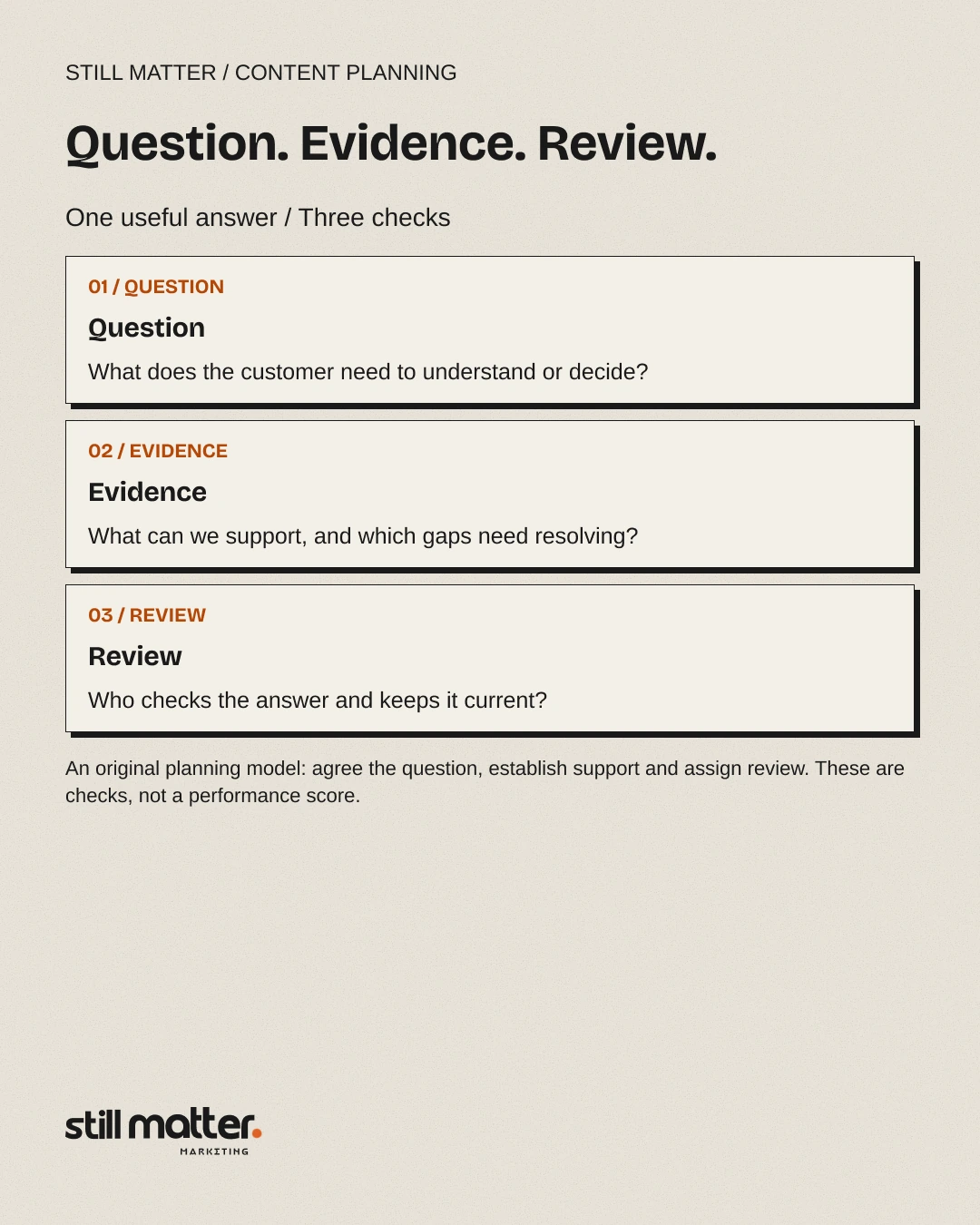
Question. Evidence. Review.
Still Matter / Content planning
One useful answer / Three checks
- 01 / Question
- What does the customer need to understand or decide?
- 02 / Evidence
- What can we support, and which gaps need resolving?
- 03 / Review
- Who checks the answer and keeps it current?
An original planning model: agree the question, establish support and assign review.
These are checks, not a performance score.
The output is a clear planning decision.
It is not a score, a completed booking or proof that every agent can use the route.
Keep capability claims specific.
Does every business need an AI agent?
No.
First find a customer task worth improving.
Clear information and a reliable human handoff may be enough.
Does showing up in an AI answer mean my site is ready?
No.
Being mentioned and completing a task are different checks.
Do not infer one from the other.
Should I remove bot restrictions?
Do not change access rules just to fit a label.
Have the owner check the named provider and purpose.
This guide does not prescribe crawler settings.
Is this a website test or a reporting method?
Neither.
It helps scope a customer task.
A technical test needs its own environment and permissions.
The existing audit handles AI-answer observations.
Improve the handoff that needs work.
If the offer is hard to understand, Content & growth can help clarify the facts and next step.
If the task exposes a broken or unclear website journey, Websites & AI systems is the relevant service conversation.
Bring the worksheet and the specific uncertainty.
Agree the scope before choosing an integration or promising automated completion.
For a separate internal workflow, see small-business automation examples.
That is a different job from helping a customer find and contact you.
Three terms used in this guide.
- AI visibility
- How a business appears in AI-assisted discovery. Appearance alone does not establish a completed task.
- Customer journey
- The steps and questions a person may work through while deciding and acting.
- AI agent
- A system that can choose steps and use tools within the access and limits it has been given.
Named examples, bounded claims.
Primary sources checked 21 October 2026.
The restaurant announcement is a historical example.
Current help pages describe the hotel and business-call flows.
Features and eligibility can change.
- Google: restaurant search and booking-page handoff, August 2025
- Google Travel Help: hotel booking in AI Mode
- Google Business Profile Help: automated calls and texts
The journey and worksheet are Still Matter planning methods.
Cedar Cycle Works is fictional.
We reviewed documentation; we did not place bookings, call businesses or run a live agent transaction.
The reused diagrams are conceptual aids, not performance evidence.
This article claims no ranking gain, universal compatibility or deployed Still Matter assistant.

Written by Jake Tripp
Founder of Still Matter. Brand strategy and hands-on marketing for small and growing businesses.